Daniella Maison
SOCIAL JUSTICE
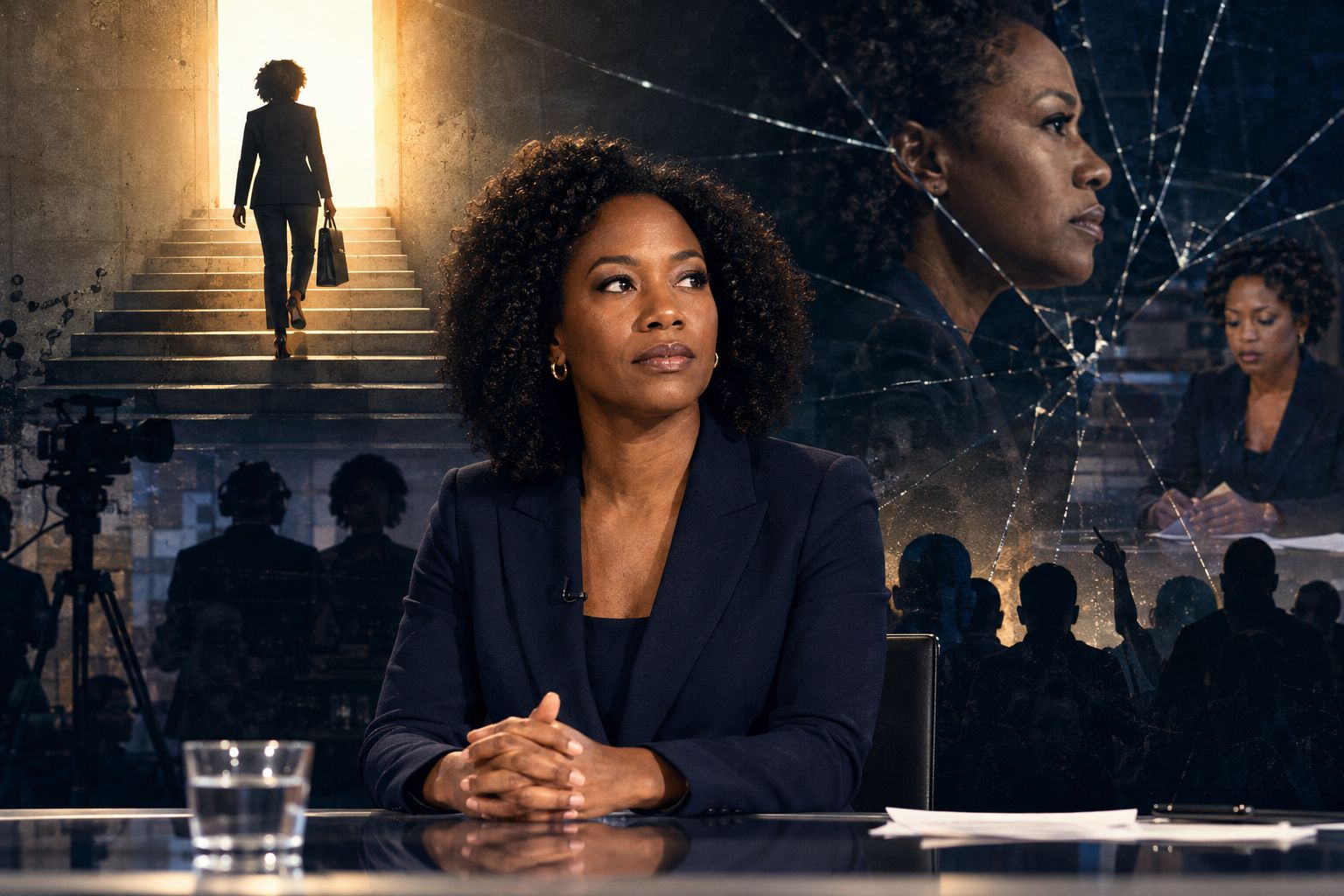
“What happens when Black success is no longer seen as evidence of progress, but as proof that the barriers have disappeared?
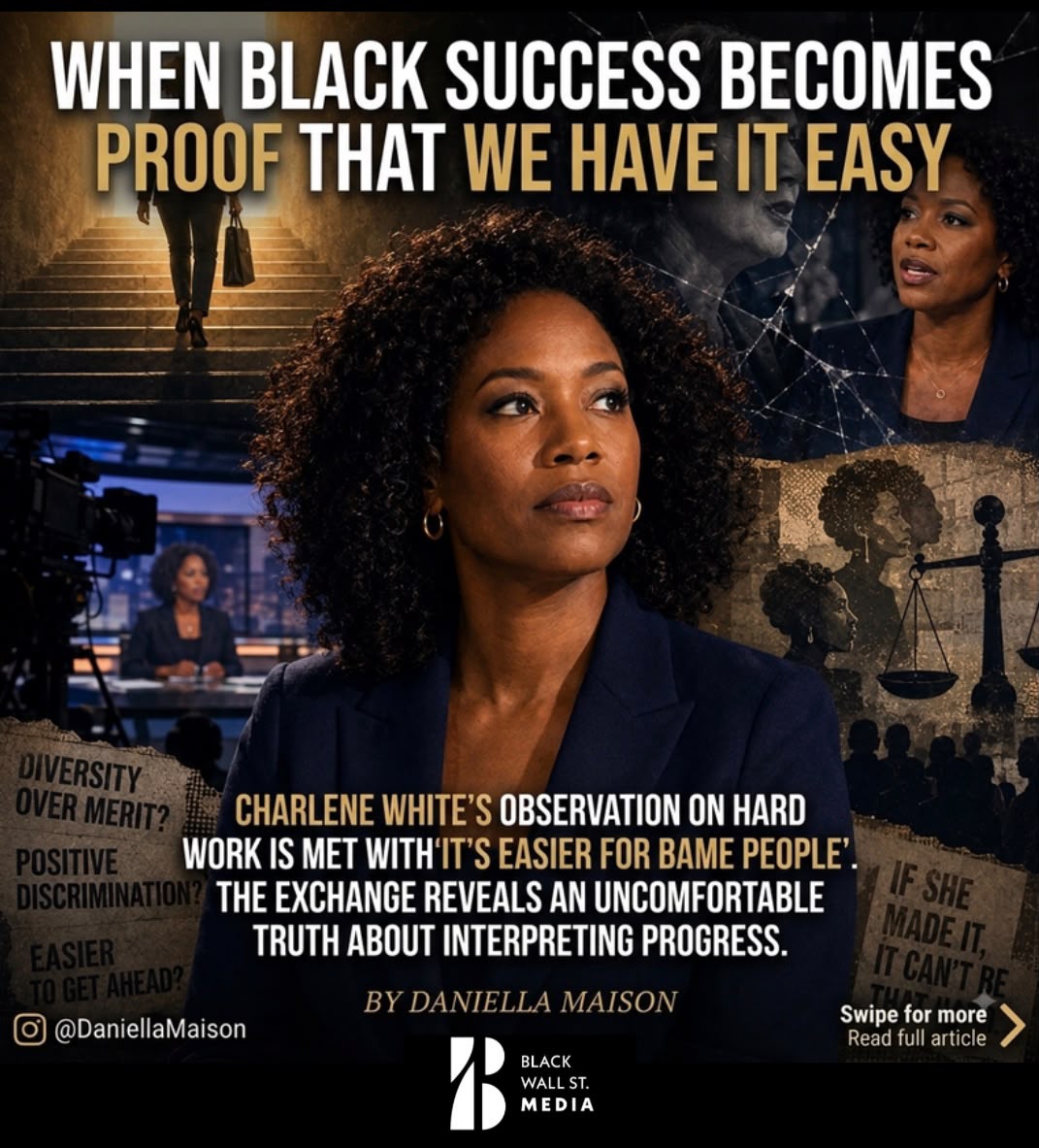
Daniella Maison examines the exchange between Charlene White and Jan Leeming and the uncomfortable assumptions behind it. Why does the success of a Black woman so often become evidence that the system must now be fair?
Representation is not privilege. Progress does not erase the barriers that came before it. Read the full article and join the conversation about race, merit and what Black success really means.”
Daniella MaisonEditor of Social Cause Issues
We design A Perfect Fit for Black Women
We’re breaking barriers of one-size-fits-all culture of mainstream fashion to a more customised fit for you.
WHERE HERITAGE HITS HOME
The Cornrow is a homeware curation dedicated to celebrating a modern Black aesthetic.
Charlene White said Black women have had to work incredibly hard to get ahead. Jan Leeming replied that BAME people now have it easier.
That exchange says something uncomfortable about the way Black success is increasingly being interpreted. Apparently, once enough of us make it through the door, the existence of the door itself is forgotten.
This week, former BBC newsreader Jan Leeming publicly criticised ITV presenter Charlene White’s presenting style, calling it condescending and questioning whether she could “hack it” as a newsreader.
White responded by saying she was surprised to be criticised by a woman she had admired as a child, adding that in an industry where women, especially Black women, have had to work incredibly hard to get ahead, that kind of disrespect from another female journalist felt like something from a bygone era.
Leeming’s response was telling; she said the criticism had nothing to do with colour and then added that she believed it was now “far easier” for BAME people to get ahead in all walks of life.
That exchange matters because it captures a contradiction Black women know well. We are told we have had to fight less hard precisely because we can now be seen.
A Black woman can name the difficulty of navigating an industry historically dominated by white men and women, and her very presence within that industry is then used as evidence that the difficulty no longer exists.
Representation becomes proof against discrimination, success becomes proof against struggle, and visibility itself is recast as privilege. We climb the mountain and are then told our presence at the summit proves there was never a mountain at all.
Representation tells us who has become visible; privilege tells us who holds structural advantage. The two are not interchangeable.
A Black woman occupying a prominent role in television does not prove that Black women as a group have somehow leapfrogged everybody else. It may simply prove that barriers have shifted enough for some women to get through them.
There is something particularly revealing about the gender dynamic here. Charlene White did not say Black women are uniquely disadvantaged, nor did she deny that women generally have had to fight for space in broadcasting.
She placed Black women within that broader female struggle. Her point was additive, not competitive: women have had to work hard, and Black women have faced an additional layer within that. Yet Leeming’s response transformed that acknowledgement of unequal experience into a claim of preferential treatment.
That move is becoming increasingly familiar. When Black women speak about exclusion, we are accused of grievance. When we succeed, our success is used to suggest exclusion no longer matters. And when we become more visible, that visibility itself is treated as evidence that we are now being favoured.
If we are absent, the system is presumed neutral. If we arrive, the system is presumed generous. If we excel, the system is presumed biased in our favour.
It is a remarkably convenient equation: whatever Black women do, the system itself escapes examination.
There is also a wider political atmosphere shaping how these arguments are heard. Reform-style rhetoric has repeatedly framed immigration and equality through the language of unfairness: migrants are supposedly being housed in luxury while ordinary Britons struggle, newcomers are portrayed as receiving preferential treatment, and diversity measures are cast as evidence that somebody else is being pushed to the back of the queue.
The details vary, but the emotional message is remarkably consistent: someone else is getting what should have been yours.
That matters because once politics teaches people to understand progress as a competition for scarce advantage, the success of a Black woman can begin to look like somebody else’s loss.
Her visibility is no longer read simply as evidence that barriers have shifted; it becomes evidence that the system must have tilted in her favour.
Representation stops looking like social progress and starts to look like redistribution between racial groups. Black advancement becomes a receipt somebody else is encouraged to believe they paid for.
The sharper point is that meritocracy is often invoked selectively. When a minority candidate succeeds, diversity initiatives are scrutinised as though they may have displaced merit. But meritocracy is not a neutral system floating above race, class, networks, institutional preference, and inherited advantage.
The question should not be whether standards matter (obviously, they do) but why “merit” becomes such an urgent public concern when the successful person is perceived to have benefited from diversity policy.
This is how racism can mutate without disappearing. It does not always announce itself through explicit racial hostility. Increasingly, it can present itself as a defence of fairness: we are not against minorities, we are simply asking why they seem to be getting more.
That framing is politically powerful because it turns equality into suspicion. If a Black woman rises, somebody else must have been overlooked.
If a minority person enters a prestigious institution, somebody else must have lost their place.
If representation improves, somebody else must now be disadvantaged. Prejudice becomes infinitely harder to challenge once it learns to speak the language of fairness.
The problem is that this relies on a fantasy about what existed before diversity initiatives: a perfectly neutral meritocracy in which the best people simply rose to the top. But Britain’s institutions were never floating above class, race, family networks, educational privilege, social connections, or inherited advantage. Equality measures did not introduce identity into systems that had previously been blind to it; they were introduced because identity and background were already shaping who got through the door.
That does not mean every diversity policy is beyond criticism. It does mean that one visible Black woman, one diversity initiative or one successful minority professional cannot logically establish that racial inequality has reversed. We would never apply that reasoning consistently.
When a white executive fails, nobody concludes that white people have been over-promoted. When a white politician proves incompetent, nobody launches a national debate about whether white candidates have been benefiting from unfair representation schemes.
Their failures remain individual. Black success, however, is often made collective, and our achievements are expected to prove something about race itself. White mediocrity is permitted to remain personal; Black excellence is routinely turned into social evidence.
That is why Jan Leeming’s remark is worth examining beyond the immediate television spat. The issue is not whether Black people have made progress. We have. The issue is what people are beginning to infer fro
m that progress.
There is something deeply revealing about a society that can spend generations excluding people from visible positions, finally begin to see them occupy those positions, and then point to their presence as evidence that they now have it easier.
Black women can be more visible than we were twenty years ago and still encounter racism. We can occupy senior positions and still be subjected to assumptions about how we got there.
We can succeed and still work within institutions whose cultures were not built with us in mind. Those things can all be true at once.
Charlene White’s response was therefore more significant than the spat itself. She named a reality many women recognise: getting ahead in public life has historically demanded enormous resilience.
She then named the further reality that Black women have often had to navigate an additional layer of scrutiny and exclusion.
What is revealing is how quickly that observation was answered with the suggestion that Black people now have it easier.
Progress is not privilege. Visibility is not dominance. And a Black woman succeeding in a space that once barely admitted Black women is not evidence that the playing field has tilted in her favour; sometimes it simply means she worked extremely hard to get onto it at all.
- Why Did Britain Need to See Jane, Christina, and Rebecca as Little Girls?
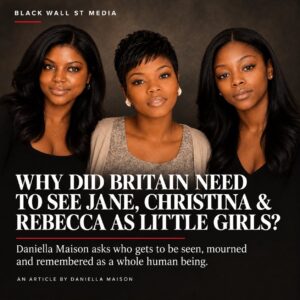 Why did Britain need to see Jane, Christina and Rebecca as little girls to recognise their humanity? In this powerful and thought-provoking article, Daniella Maison challenges us to confront how race, media representation and perceptions of Black womanhood shape whose pain we recognise and whose vulnerability we acknowledge. Their childhood photographs may move us, but they should never have been necessary for us to see their humanity. Read Daniella Maison’s compelling article and join the conversation. Why should Black women have to be seen as children to receive the tenderness and compassion they deserve?
 - The Jamaican Who Stood Beside Kenyatta
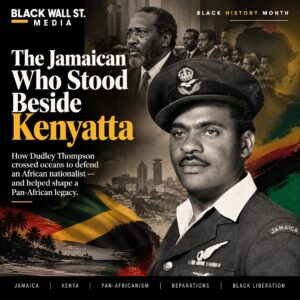 How did a boy from Kingston, Jamaica, become one of Britain’s most influential thinkers on race, culture and identity? This Black History Month, discover the story of Stuart Hall, the man who challenged Britain to question its history, its identity and who gets to define what it means to be British. Read his remarkable story and discover why his legacy still matters today.
 - Professor Folarin Shyllon Reclaiming Africa’s History
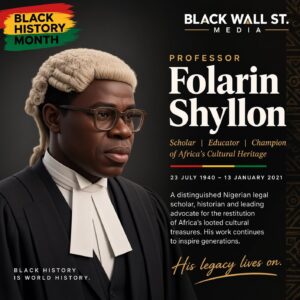 Black History Month: Professor Folarin Shyllon — Reclaiming Africa’s History From uncovering the forgotten history of Black people in Britain to championing the return of Africa’s looted cultural treasures, Professor Folarin Shyllon dedicated his life to truth, justice and reclaiming heritage. Discover the remarkable legacy of a pioneering Nigerian legal scholar who challenged historical erasure and championed Africa’s right to its own history. Because reclaiming our history is reclaiming our power. Read the full article with Black Wall St. Media. Black history is world history.
 - ALLISTER VICTOR BAIN: THE MAN, THE ARTIST AND THE HISTORY WE MUST NOT FORGET
 This Black History Month, Black Wall St. Media pays tribute to Allister Victor Bain, the Grenadian-born artist, storyteller and cultural pioneer whose creativity helped shape Caribbean and Black British cultural life. Through the heartfelt memories of his friends, colleagues and family, we celebrate not only his remarkable contribution to the arts, but the man behind the legacy. His story is a powerful reminder that our pioneers deserve more than to be remembered after they are gone, their lives, work and history must be preserved for generations to come. Read the tribute. Discover his legacy. Help keep his story alive.
 - When Your Achievements Are Treated as a Question
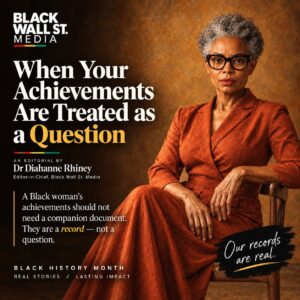 When a Black Woman Has to Prove Her Worth What happens when decades of achievement are met with doubt, and a Black woman finds herself having to justify not just her work, but her right to be in the room? This powerful and deeply personal reflection explores race, credibility, the emotional cost of constant scrutiny, and why being told to “let it go” is not always enough. This Black History Month, it is time to look beyond celebration and confront the realities Black women continue to face in the workplace.





Hair Freedom EXPO 2026
Read More
100 Black Women Campaign
Read More
Black Parenting: Discipline as Protection
Read More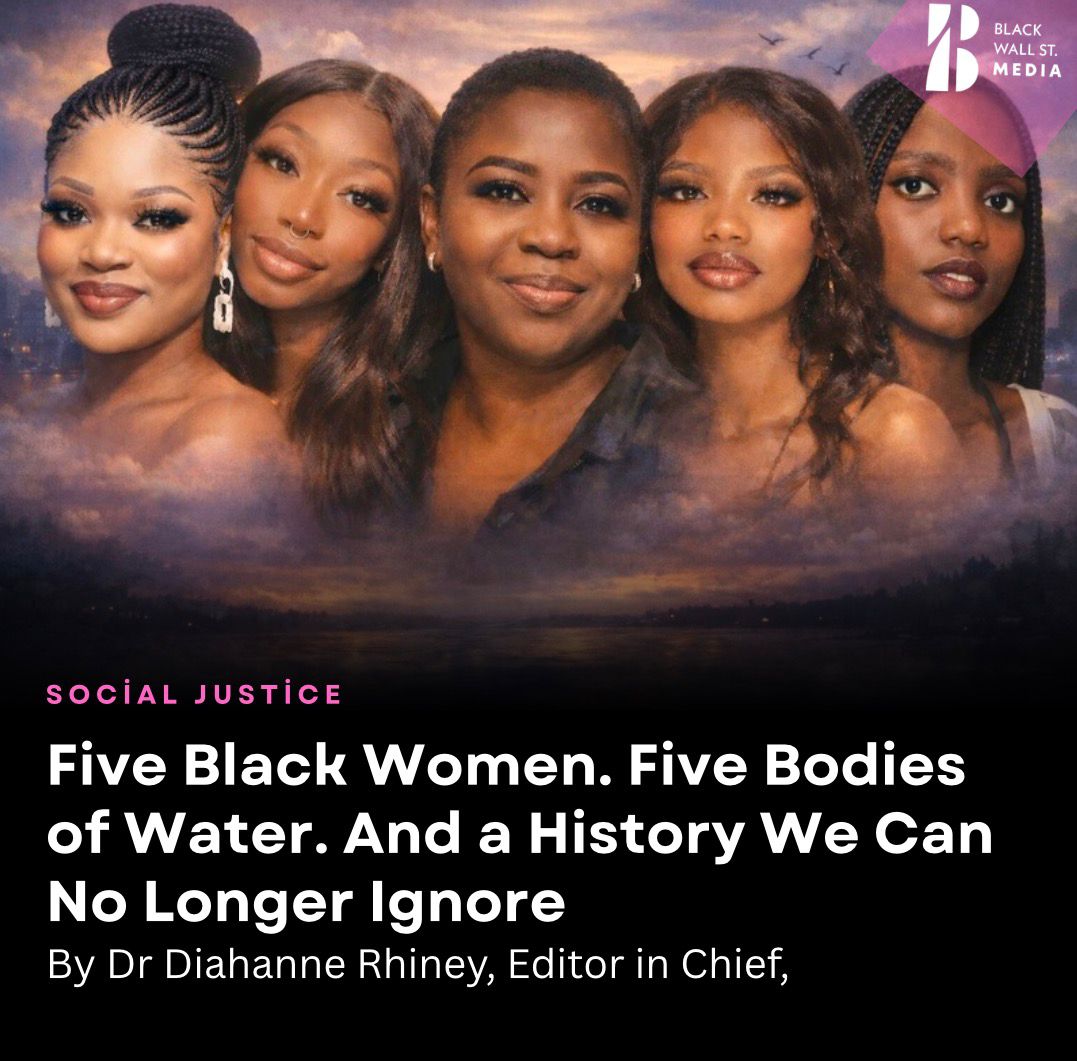
Five Black Women. Five Bodies of Water. And a History We Can No Longer Ignore
Read More
International Women’s Day: The Diaspora Women Who Carry the World on Their Shoulders
Read More
When Inclusion and Impact Collide at the BAFTAs
Read More
When Oversight Falls Silent
Read More
Ras Judah: The Elder Who Stood So We Could Stand
Read More
A Giant Has Fallen. What Jesse Jackson Meant to the Diaspora
Read More