
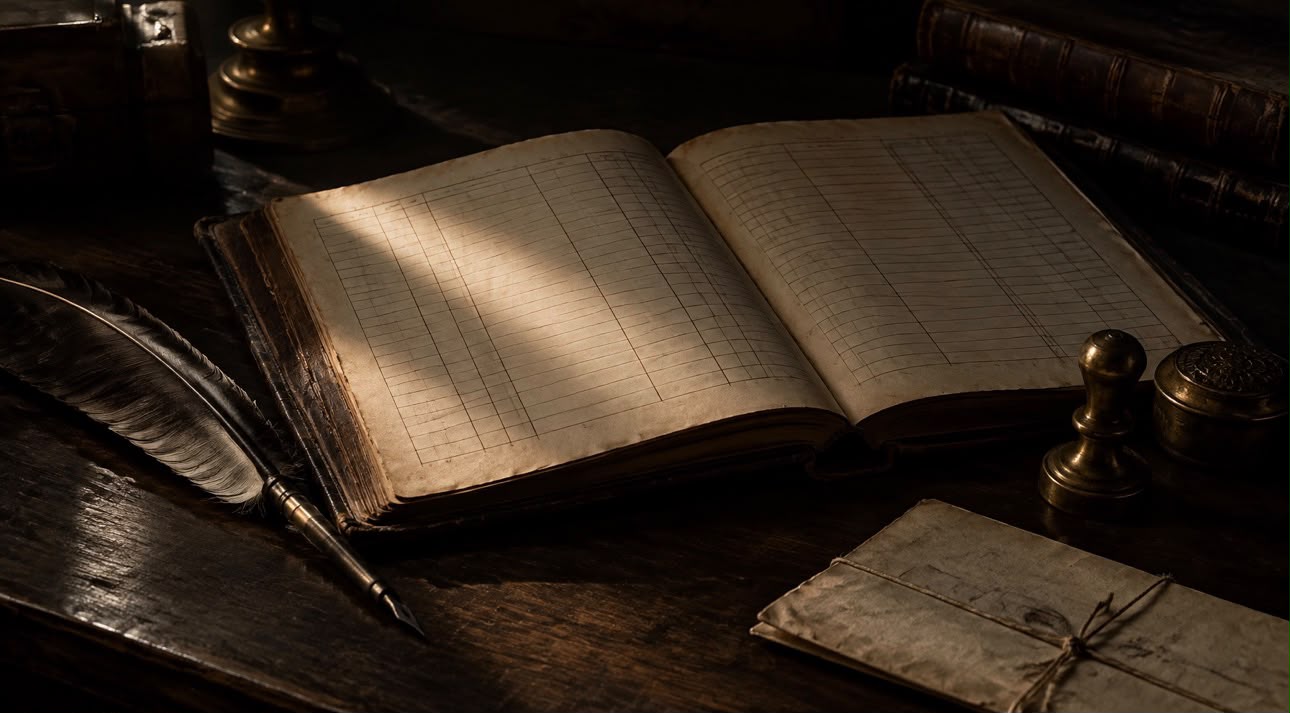
History
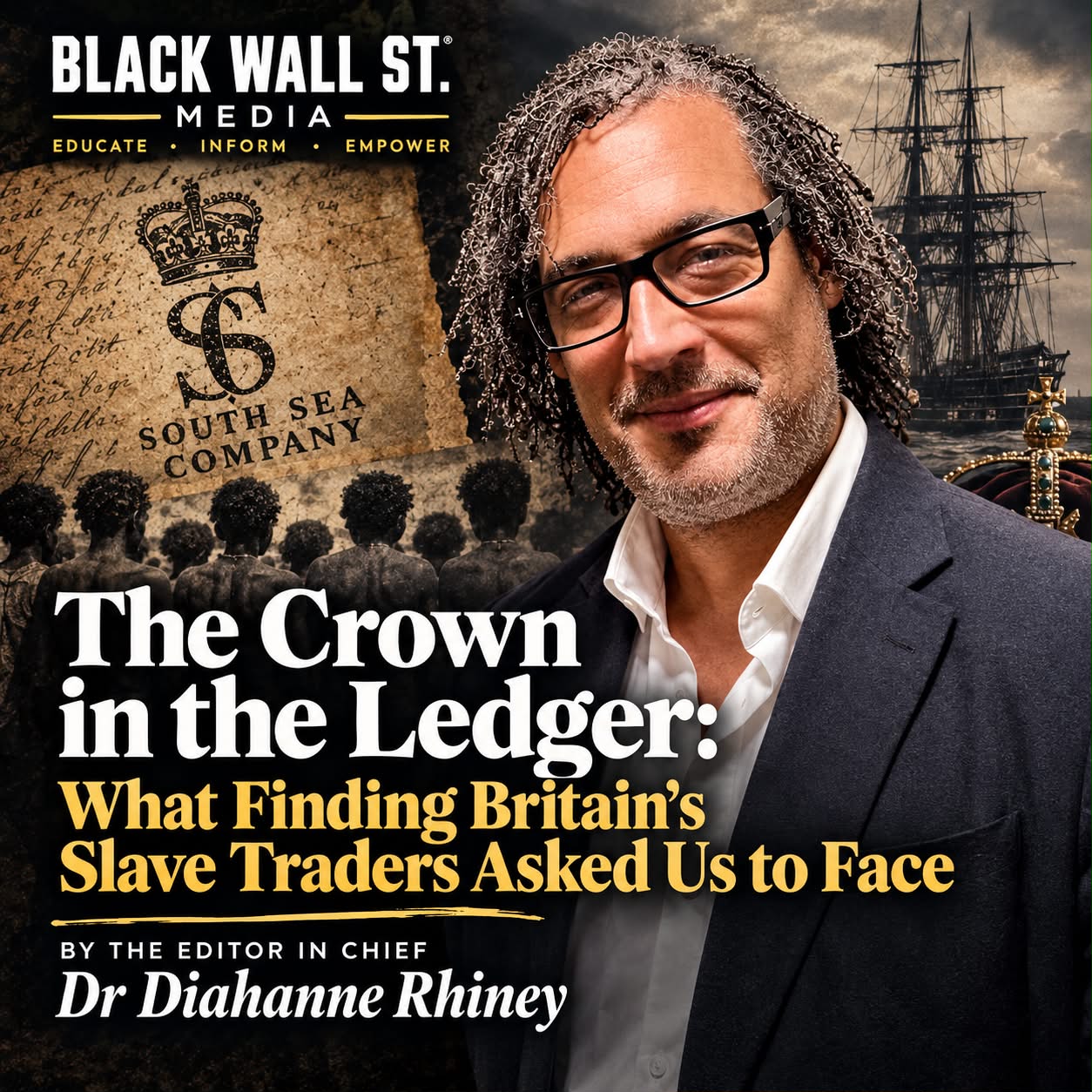
“What happens when Britain’s history is no longer told through monuments, wealth and institutions, but through the ledger behind them?
Finding Britain’s Slave Traders with David Olusoga brings names, companies, royal connections and fortunes into focus, forcing us to confront how deeply the transatlantic slave trade was embedded in British society.
In “The Crown in the Ledger,” we explore what these records reveal about wealth, power, responsibility and the legacy that remains today.
Read the full article and ask yourself: who owns what, who benefited, and what does honest accounting look like?”
Dr Diahanne RhineyEditor in Chief
I watched Finding Britain’s Slave Traders with David Olusoga* knowing a great deal already.
I knew the broad history. I knew Britain’s wealth was not built only through invention, industry and respectable commerce. I knew it was also shaped by the trafficking, enslavement and exploitation of African people. And yet, hearing the details never fails to pierce my heart. There is something about seeing the names, the numbers, the documents and the deliberate decisions that makes the past feel painfully close. You can know the history and still be wounded by it all over again.
The series is built around the Register of British Slave Traders. Led by Professor William Pettigrew of King’s College London, with historian Dr Nicholas Radburn of Lancaster University, the project identifies around 13,000 individuals and hundreds of institutions connected to Britain’s transatlantic slave trade between 1563 and abolition across the British Empire in 1807. Biographical details are available for up to 10,500 people. It is described as the most comprehensive examination yet of a national community of slave traders, and watching it unfold felt like watching a country’s carefully polished portrait being turned around to reveal the ledger behind it.
More than three million enslaved African men, women and children were transported through Britain’s trafficking operations. An estimated half a million died during the forced journeys. Those figures are almost too large for the heart to hold, which is partly why the names matter so much. Numbers can become abstract. Names return people to the story. They remind us that this was not an unfortunate system that moved forward by itself. It was organised by people, financed by people, insured by people, defended by people and made respectable by people whose wealth and influence often continued long after the ships had returned.
And then there is the branding iron.
New research found that enslaved Africans were branded on the left shoulder with a mark showing an emblem of the British Crown, with the South Sea Company logo beneath it. The irons were made in England and sent out by the company’s London directors. A letter from February 1714 provided detailed instructions. Dr Radburn found the mark in the South Sea Company archives at the British Library in 2022, in a volume called *The Register of Instruments*. I found myself pausing at that detail. Not because branding was unknown in the history of enslavement, but because this particular mark brought together monarchy, company and body in one horrifying image.
The Crown was not an artistic flourish. It was a claim of ownership and authority. The company symbol beneath it was not merely a piece of corporate identity. It showed how commercial power and state power could sit together, stamped directly onto human flesh. Professor Pettigrew has described the branding as a dramatic and harrowing symbol of the monarchy’s relationship with slavery. I understand why. It is difficult to imagine a clearer representation of how an institution of government and a private company could participate in the same machinery of violence.
We must also be precise. The monarchy as an institution is not identical to every individual who has occupied the throne, and historical responsibility should not be reduced to a simple accusation against every royal person across time. But precision cannot become evasion. The evidence shows that members of the royal family and the institution of the Crown were involved in establishing, supporting and benefiting from ventures connected to the trafficking of enslaved Africans. After Charles I was executed, when the monarchy was at its lowest ebb, members of the royal family helped relaunch its finances and reputation by investing in the transatlantic slave trade. That is not a marginal footnote. It is part of the story of restoration and power.
Elizabeth I and her inner circle backed John Hawkins’s enslaving voyages from the 1560s, lending Royal Navy ships in return for a share of the profits. After the Restoration in 1660, the Crown established two royally chartered companies before the Royal African Company was founded in 1672. Led by James II and Prince Rupert, and enforced by the Royal Navy, the Royal African Company became the largest single trafficker of enslaved African people in the history of European enslavement. It transported at least 150,000 captive men, women and children.
The company’s shareholders and governors included royal courtiers, Tory and Whig MPs, financiers, bankers, merchants and City of London aldermen. The names are uncomfortable because they sit so close to the people and institutions we are taught to admire. George Frideric Handel and John Locke were shareholders. Sir Christopher Wren chaired a Royal Society meeting in 1682 that voted to invest in the company. The Register identifies more than 100 MPs as investors, dozens of directors and original financiers of the Bank of England, more than 1,000 women investors and 45 Church of England clergymen who invested in the Royal African Company.
This is where the programme becomes more than a history of cruelty, although the cruelty must never be softened. It becomes a history of capital formation. Who had money to invest? Who had access to charters, contracts and protection? Who could convert violence into dividends, public office, social status and institutional influence? The answer was not one secret group operating beyond respectable society. The investment reached through parliament, the City, the church, science, banking, the aristocracy and the Crown.
The royal monopoly was eventually dismantled through parliamentary pressure, with full deregulation approved in 1712. The 1750 Act that wound up the Royal African Company made the position even clearer. It described the trafficking of enslaved people as very advantageous to Great Britain and said it ought to be free and open to all His Majesty’s subjects, with a fee of 40 shillings to join. The language is chilling because it turns a system of organised human suffering into an economic opportunity available to anyone with the means to participate.
The examples from Bristol and Liverpool bring that national system into local focus. Bristol trader Richard Farr outfitted at least 38 enslaving ships that trafficked more than 10,000 people. James Laroche outfitted at least 105 ships carrying more than 30,000 people. In Liverpool, 51 mayors were traffickers. Arthur Heywood was linked to 80 voyages and an estimated 21,648 people. His bank later became connected to Barclays through takeovers. Bryan Blundell founded a school. William Earle was linked to 117 voyages and an estimated 36,565 people.
These details matter because they expose the distance between public reputation and private profit. A man could be remembered as a civic leader, an educator, a benefactor or a successful businessman while the wealth that helped sustain his position was connected to the trafficking of human beings. This is not an argument that every later institution can be reduced to one historical transaction. It is an argument for tracing the pathways of wealth honestly. Capital does not disappear because its origins become inconvenient. It is transferred, invested, inherited, expanded and normalised.
When parliament abolished enslavement in 1833, around twenty million pounds was paid in compensation to the owners of enslaved people. On the lowest calculation, that is worth roughly 2.7 billion pounds today. Nothing was paid to the people who had been enslaved. The state compensated those who claimed ownership. The people whose labour, bodies and families had been treated as property received no payment, no meaningful restoration and no national settlement.
That unpaid compensation sits at the centre of the question Black Wall St Media must keep asking. What does it mean when the wealth created through Black suffering was allowed to become banks, businesses, buildings, universities, cultural institutions and family fortunes, while the people who generated it were left with freedom but not repair? What does it mean when the descendants of those who profited can inherit security as though it arrived without a history, while the descendants of those who were enslaved are told that the past is too distant to discuss?
In March 2026, a large majority of countries supported a United Nations declaration led by Ghana’s President John Dramani Mahama describing the trafficking and racialised chattel enslavement of Africans as the gravest crime against humanity. Britain abstained. Jamaica has delivered a petition to King Charles seeking a Privy Council ruling on the legality of the British position. Downing Street has said that the trade was abhorrent but that the United Kingdom does not pay reparations. Buckingham Palace has said that the King has expressed a personal and wholehearted commitment to promoting greater understanding of slavery and finding ways to address historic wrongs.
Understanding is important. It is not the same as accounting.
Naming investors is not only symbolic. It is an economic act. It tells us where to look, what to trace and which institutions may need to examine their own foundations. It helps us understand why some families and organisations accumulated stability across generations, while Black communities were denied land, rights, protection and access to capital. It allows us to challenge the comforting idea that Britain’s wealth simply emerged from hard work and good fortune. Hard work was certainly involved, but whose work, under what conditions and who was permitted to own the result?
I finished the programme with tears in my eyes, but not with despair. Tears are not weakness. Sometimes they are evidence that an inheritance is still being reckoned with. The pain tells us that this history is not dead. It lives in the distribution of ownership, in the shape of our cities, in the institutions we trust and in the opportunities that remain open or closed.
The work ahead is honest accounting. It is rigorous research without defensiveness. It is asking institutions to examine their archives and publish what they find. It is engaging seriously with reparatory justice rather than treating the word as a threat. It is also about what we build now. Black people have always created businesses, mutual aid networks, schools, cultural institutions and communities in conditions designed to restrict us. We must continue building ownership, circulating capital and creating institutions that can outlast the moment.
Finding Britain’s Slave Traders asked us to look at the crown in the ledger. I believe we must now look at the future in the same way. Who owns what? Who is resourced? Who is protected? Who gets to build wealth that can be passed on? We cannot change the fact that the debt was created, but we can refuse to let silence manage it. We can name the history, demand accountability and build with intention. We can grieve what was taken while creating what was denied. That is not a retreat into the past. It is the beginning of a more truthful future.

- Why Did Britain Need to See Jane, Christina, and Rebecca as Little Girls?
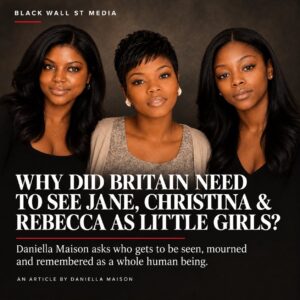 Why did Britain need to see Jane, Christina and Rebecca as little girls to recognise their humanity? In this powerful and thought-provoking article, Daniella Maison challenges us to confront how race, media representation and perceptions of Black womanhood shape whose pain we recognise and whose vulnerability we acknowledge. Their childhood photographs may move us, but they should never have been necessary for us to see their humanity. Read Daniella Maison’s compelling article and join the conversation. Why should Black women have to be seen as children to receive the tenderness and compassion they deserve?
 - The Jamaican Who Stood Beside Kenyatta
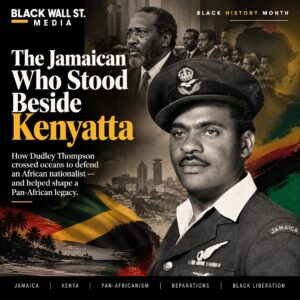 How did a boy from Kingston, Jamaica, become one of Britain’s most influential thinkers on race, culture and identity? This Black History Month, discover the story of Stuart Hall, the man who challenged Britain to question its history, its identity and who gets to define what it means to be British. Read his remarkable story and discover why his legacy still matters today.
 - Professor Folarin Shyllon Reclaiming Africa’s History
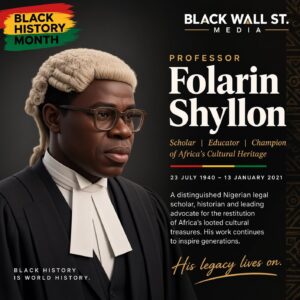 Black History Month: Professor Folarin Shyllon — Reclaiming Africa’s History From uncovering the forgotten history of Black people in Britain to championing the return of Africa’s looted cultural treasures, Professor Folarin Shyllon dedicated his life to truth, justice and reclaiming heritage. Discover the remarkable legacy of a pioneering Nigerian legal scholar who challenged historical erasure and championed Africa’s right to its own history. Because reclaiming our history is reclaiming our power. Read the full article with Black Wall St. Media. Black history is world history.
 - ALLISTER VICTOR BAIN: THE MAN, THE ARTIST AND THE HISTORY WE MUST NOT FORGET
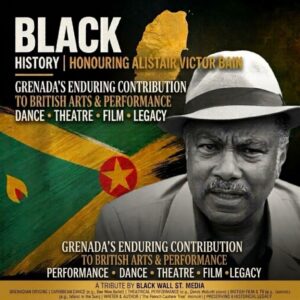 This Black History Month, Black Wall St. Media pays tribute to Allister Victor Bain, the Grenadian-born artist, storyteller and cultural pioneer whose creativity helped shape Caribbean and Black British cultural life. Through the heartfelt memories of his friends, colleagues and family, we celebrate not only his remarkable contribution to the arts, but the man behind the legacy. His story is a powerful reminder that our pioneers deserve more than to be remembered after they are gone, their lives, work and history must be preserved for generations to come. Read the tribute. Discover his legacy. Help keep his story alive.
 - When Your Achievements Are Treated as a Question
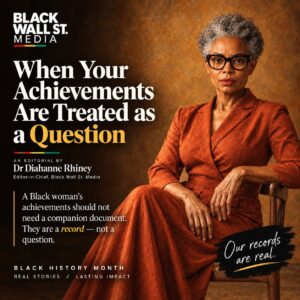 When a Black Woman Has to Prove Her Worth What happens when decades of achievement are met with doubt, and a Black woman finds herself having to justify not just her work, but her right to be in the room? This powerful and deeply personal reflection explores race, credibility, the emotional cost of constant scrutiny, and why being told to “let it go” is not always enough. This Black History Month, it is time to look beyond celebration and confront the realities Black women continue to face in the workplace.



Editor’s Letter April 2026
Read More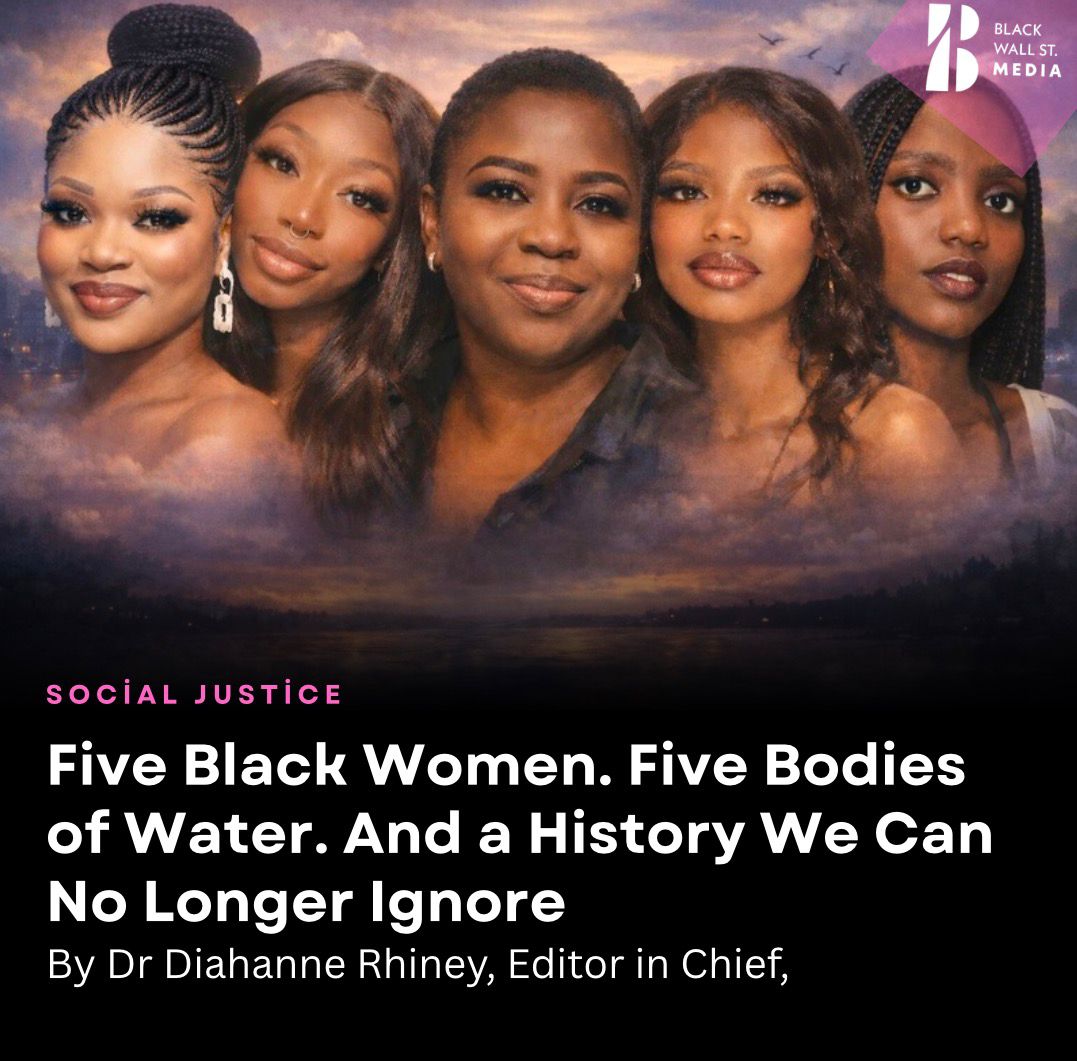
Five Black Women. Five Bodies of Water. And a History We Can No Longer Ignore
Read More
Mother’s Day and the Quiet Legacy of Our Mothers
Read More
Editor’s Letter March 2026
Read More
Locked Out of the Purse Strings
Read More
Editors Letter – January 2026
Read More
Editors Letter – October 2025
Read More
Editors Letter – September 2025
Read More
Editors Letter – August 2025
Read More



Thanks Diahanne, for so eloquently and forcefully amplifying the points made by the historians in the recent BBC documentary.
My thoughts mirror yours. Our task through fora such as Black Wall St Media, is to educate and inform those who are still ignorant of these crimes and signpost them to further information. This is indeed a pressing and urgent assignment.
As someone of Barbadian heritage, I am painfully aware of the history of branding slaves on the island.
On the island’s parish of St. John, the most heavily documented instance of this heinous act occurred on the Codrington Plantations, which were bequeathed in 1710 to the Society for the Propagation of the Gospel in Foreign Parts (SPG), the missionary arm of the Church of England.
Enslaved laborers on these church-owned estates were forcibly branded on their chests with the word “Society” to mark them as the legal property of the religious organization. This brutal treatment sparked fierce resistance, culminating in 1741 when a group of enslaved workers marched from St. John to Bridgetown in a collective protest that successfully forced the SPG to formally abolish branding on their estates.
Christopher Codrington was one of the wealthiest slave owners in the Caribbean. His vast wealth contributed to a library named after him at his alma mater, All Souls College, at Oxford University. In 2020, following the George Floyd murder and the ensuing wave of corporate global and institutional guilt around racism, Oxford’s All Souls College formally stopped using the name “Codrington Library” for everyday reference, reverting its official title to the “All Souls College Library.”
Beyond corporate ownership, branding served as a public, permanent form of judicial mutilation under the draconian Barbados Slave Code to deter resistance across the parish. Colonial laws mandated that any enslaved person caught attempting to escape for a third time was to be branded on the right cheek with the letter “R” for runaway.
Furthermore, those convicted of repeated theft faced even more severe physical degradation, as authorities were legally sanctioned to slit their noses and brand their foreheads with a hot iron. These permanent physical markers ensured that any individual moving through St. John could be instantly identified by overseers, slave catchers, or colonial authorities as either corporate property or a convicted rebel.
This is why the drumbeat for reparations will only grow louder and why we must resist efforts by some to sideline calls for people across the African diaspora to revisit the historical wrongs and usher in this pivotal period of reparatory justice.