
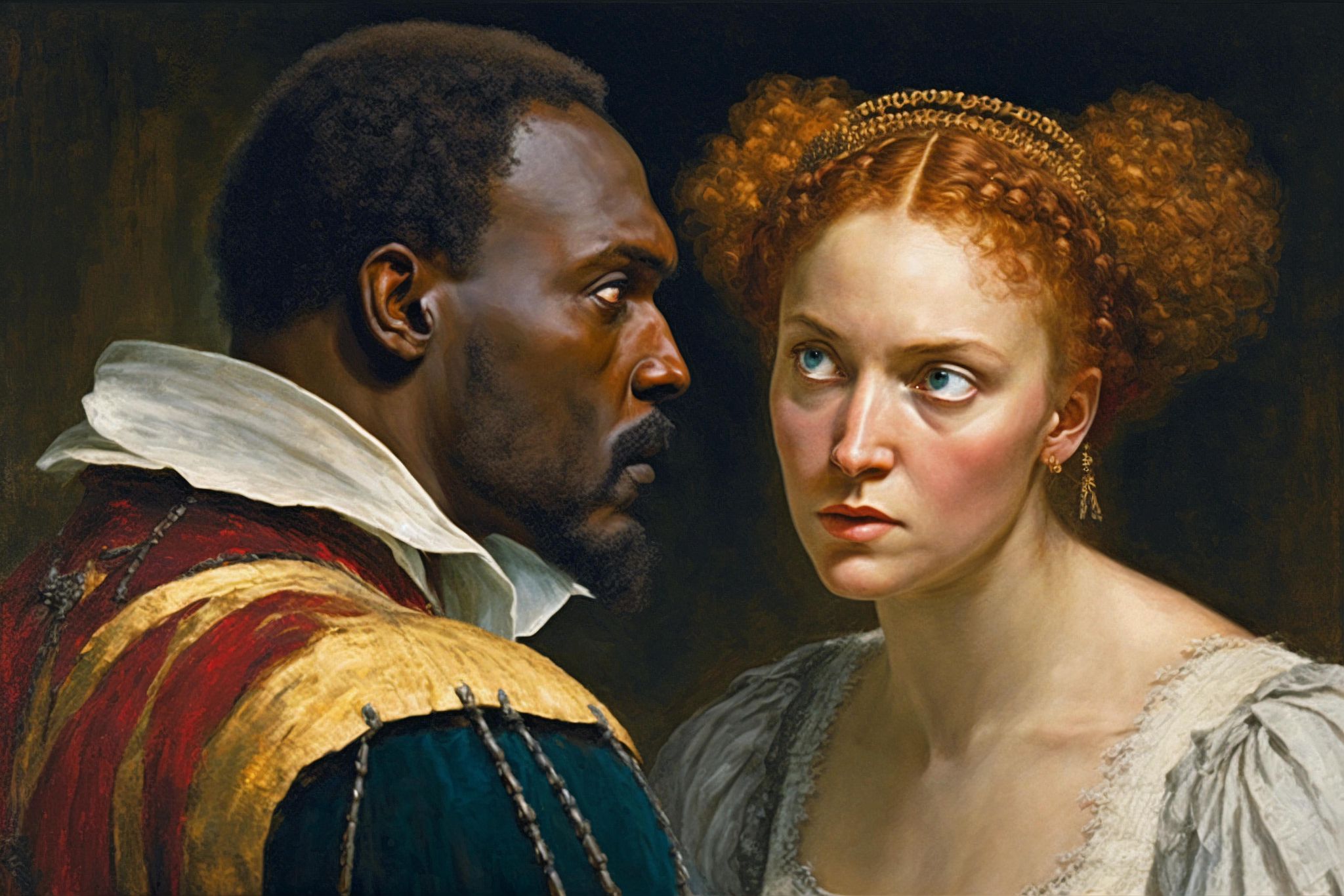
Othello: A Timeless Exploration of Jealousy, Racism, and Ambition
There are some works of literature that belong so completely to the time in which they were written that, eventually, they become historical objects. We admire them, perhaps, but we no longer recognise ourselves in them. Othello is not one of those works.
More than four hundred years after William Shakespeare placed a Black man at the centre of one of the English language’s great tragedies, Othello continues to disturb us because the questions it asks have never really gone away. What does it mean to be accepted by a society that nevertheless regards you as different? What happens when love is confronted by doubt? How easily can prejudice become part of the way a person sees themselves? And what happens when someone discovers precisely where another person’s insecurities live and decides to exploit them?
These are not merely Shakespearean questions. They belong to us. Perhaps that is why Othello remains uncomfortable. It is easier to place Shakespeare in the past than to admit that the world he was writing about contains reflections of our own.
A Black Man at the Centre of Shakespeare’s Tragedy
Othello is a remarkable figure because Shakespeare does not make him a powerless man. He is a general who has earned authority through his military ability and become important to the state of Venice. Yet his position does not protect him from the racial attitudes of the society around him. He can be respected for his achievements while still being judged through the fact that he is Black.
That contradiction is central to the play.
Othello has achieved status, but status does not make prejudice disappear. His success does not erase the assumptions attached to his identity, and his marriage to Desdemona exposes those tensions even more clearly. The society that values his service does not necessarily know how to reconcile that service with a Black man crossing one of its social and racial boundaries.
That is one reason the play remains so powerful. Representation can demonstrate progress without proving that prejudice has disappeared. A person can enter a powerful institution without escaping every assumption that surrounds their identity. Othello understands this contradiction, but it does not make it the whole story.
The more immediate danger comes through jealousy.
When Doubt Becomes Destructive
Othello is often described as a tragedy about jealousy. It is, but jealousy is only the surface. Underneath it is a more troubling question: why is Othello so vulnerable to believing Iago?
Iago does not simply accuse Desdemona and expect Othello to accept the accusation. He works indirectly, giving Othello fragments of information and allowing him to draw his own conclusions. His genius lies in understanding that a person who is already afraid does not need to be given a complete lie. They can be encouraged to construct one themselves.
Once doubt enters Othello’s mind, ordinary events begin to acquire new meaning. The innocent becomes suspicious, the unexplained becomes incriminating and an ordinary object becomes proof of betrayal. The problem is no longer what actually happened, but what Othello has been persuaded to believe happened.
That is the real power of Iago.
He does not control reality. He controls the interpretation of reality.
Othello’s relationship with Desdemona therefore collapses not because he stops loving her, but because trust is gradually replaced by a version of events that he believes more than the woman standing before him.
Why Iago Still Feels Familiar
This is where Othello reaches beyond its historical setting. We live in a world saturated with information, yet information is not the same thing as truth. A photograph can lack context. A message can be misunderstood. A rumour can become accepted through repetition. A fragment of a conversation can be made to mean almost anything when the person receiving it already has reason to be afraid.
The mechanisms may change, but the vulnerability remains. People can still be persuaded to accept incomplete information as fact or to mistake confidence for evidence. Modern communication can accelerate the process, but Shakespeare’s insight is older than any technology: once people become emotionally committed to a particular interpretation, evidence that challenges it can become surprisingly difficult to accept.
Iago would not need a smartphone. He would only need an audience.
He is powerful because he understands people. He knows that resentment can be disguised as honesty, jealousy can masquerade as love and prejudice can be presented as common sense. He understands that once a person begins to fear losing something, they can be persuaded to destroy the very thing they are trying to protect.
Race Is Not a Side Issue
To understand Othello’s jealousy without understanding race, however, is to misunderstand the tragedy.
Othello is a Black man living in a predominantly white society, married to a white woman, surrounded by people who have already demonstrated that they see his race as significant. The racism in Othello is not simply language from a distant period. It establishes the social environment in which he lives.
Iago therefore does not have to invent every insecurity. He finds the vulnerabilities that already exist and turns them against Othello.
That is an important distinction.
Othello’s Blackness is not the source of his downfall. Racism, insecurity and manipulation become weapons used against him. Shakespeare presents a man whose external strength cannot entirely protect him from the psychological consequences of living in a society where his identity can be made into an issue.
Othello has spent his life establishing who he is through his actions. He has become a general and earned his reputation. Yet when Iago begins to attack his marriage, questions of race, masculinity and worth become entangled with his fear of losing Desdemona.
Iago knows exactly where to press.
Masculinity, Vulnerability and Violence
Othello is a powerful man, but he is not emotionally invulnerable. He can command soldiers, yet he cannot command his own fear. He can confront an enemy on a battlefield, yet he struggles to confront the uncertainty growing inside his marriage.
This is not simply a story about male violence. It is also a story about emotional vulnerability and what happens when that vulnerability has nowhere safe to go.
Othello wants certainty. He wants an answer, an assurance that Desdemona loves him and that the world he thought he understood is still intact. Iago offers him certainty. It is false certainty, but it is certainty nonetheless.
That is often what manipulation provides. It takes the unbearable complexity of life and replaces it with a simple story: someone is to blame, someone has betrayed you, someone has taken what belongs to you, someone must pay.
There is comfort in that simplicity.
There is also danger.
Othello’s love becomes possessiveness, his insecurity becomes certainty and his certainty becomes violence. The progression is horrifying precisely because each stage appears to grow naturally from the one before it.
Desdemona becomes trapped inside a story she did not write. She knows what she has done and what she has not done, but truth becomes increasingly powerless against the narrative Othello has accepted. She speaks, but she is not believed. Othello listens, but increasingly hears Iago.
There is something particularly disturbing about a world in which a person’s own explanation of themselves can become less important than the story somebody else has constructed about them. It is a reminder that communication means little without trust, and that listening can be harder than speaking.
The Destructive Nature of Ambition
Yet Othello is also concerned with ambition.
Iago believes he deserves more. He sees another man receiving something he believes should belong to him, and disappointment becomes resentment. There is nothing wrong with wanting more from life; ambition has driven extraordinary achievement throughout history. But there is a profound difference between wanting to rise and believing that somebody else must fall.
Iago crosses that line.
His grievance becomes an obsession, and once revenge becomes the purpose, morality becomes an inconvenience. Every generation has people who turn disappointment into resentment and resentment into blame. Shakespeare understood how quickly ambition can become destructive when recognition matters more than integrity.
Iago’s ambition is therefore not simply a desire for promotion. It becomes a desire to control the fate of other people.
That is where ambition becomes dangerous.
The Question of Identity
Perhaps the most enduring question Othello asks is about identity.
How much of what we believe about ourselves comes from within us, and how much is shaped by the voices around us?
Othello has spent his life establishing who he is through his actions. Iago attempts to replace that understanding with another version of him: an insecure husband, a betrayed man, someone whose identity and masculinity have been threatened.
The tragedy lies partly in Othello allowing another person’s interpretation to become more powerful than his own knowledge.
This is why Othello should continue to be read as a work about far more than jealousy. It is about the fragility of trust, the power of manipulation, the persistence of racial prejudice, the danger of unchecked ambition and the human need to feel secure in who we are.
Why Othello Still Matters
Great literature does not always give us answers. Sometimes it gives us better questions.
Othello asks us to look at racism without pretending that it belongs only to the past. It asks us to examine jealousy without pretending that it is simply an emotion experienced by other people. It asks us to examine ambition without pretending that success is always innocent, masculinity without pretending that strength means the absence of vulnerability, and communication without pretending that speaking is the same thing as being heard.
Four centuries later, the world in which Othello was written has disappeared, but the human beings have not. We still love, fear, envy, compare ourselves with others and carry wounds that other people cannot see. We still want to be understood. We still want to trust and be trusted. And we remain vulnerable to people who understand how to turn our fears against us.
That may be the reason Othello has survived.
Not because Shakespeare predicted social media. Not because Shakespeare’s Venice is our world. And not because the seventeenth century and the twenty-first century are the same.
It has survived because Shakespeare understood something more enduring than any particular historical period: human beings are vulnerable to the stories they tell themselves about one another.
When those stories are built upon fear, prejudice and mistrust, the consequences can be devastating.
So, is Othello relevant today?
The better question may be: how could it not be?
Othello still asks what happens when prejudice finds its way into insecurity. Iago still reminds us how easily truth can be manipulated. Desdemona still reminds us how powerless truth can become when trust has disappeared.
The tragedy is centuries old.
The questions are not.
Perhaps that is the most unsettling thing about Othello: we did not leave the world that created it completely behind.
We simply changed its clothes.
Black Wall St. MediaContributor
- Alzheimer’s the Black doctor who helped decode the disease
 🧠✨ Celebrating an Unsung Hero! Dive into the captivating journey of Dr. Solomon Fuller, a pioneer in Alzheimer's research and a standout figure in Black history. From his roots in Liberia to groundbreaking discoveries, discover the legacy of a medical trailblazer who defied adversity. 🌟
 - The Voice of the Child, Young Person and; Service User
 Whose voices are we really hearing? And what happens when we truly listen? The 3rd DARDR/DVA & Criminal Justice Summit 2026 will bring together professionals, practitioners, community organisations, academics and people with lived experience to place children, young people and service users at the heart of the conversation. Under the theme “The Voice of the Child, Young Person & Service User,” this year’s Summit will explore domestic abuse, violence, safeguarding, exploitation, trauma and criminal justice — but most importantly, how listening can move beyond consultation and become meaningful action. 📅 Friday 27 November 2026 📍 Brent Civic Centre, Wembley 💻 Hybrid Event | CPD Accredited Read more about the Summit, the conversations it will explore and how to book your place.
 - The Crown in the Ledger: What Finding Britain’s Slave Traders Asked Us to Face
 What happens when Britain’s history is no longer told through monuments, wealth and institutions, but through the ledger behind them? Finding Britain’s Slave Traders with David Olusoga brings names, companies, royal connections and fortunes into focus, forcing us to confront how deeply the transatlantic slave trade was embedded in British society. In “The Crown in the Ledger,” we explore what these records reveal about wealth, power, responsibility and the legacy that remains today. Read the full article and ask yourself: who owns what, who benefited, and what does honest accounting look like?
 - Is ‘Othello’ relevant today?
 Othello: A Timeless Exploration of Jealousy, Racism, and Ambition
 - A life lived beyond the limits of representation
 Bonnie Greer was never simply a writer, playwright or broadcaster. She was a cultural force who refused to be confined by the expectations placed on Black women in public life. From Chicago to Britain, from theatre and literature to television and institutional leadership, she built a life defined by intellect, independence and an unapologetic right to occupy space. As Britain remembers her following her death at 77, this article looks beyond the achievements and asks what her life represented: the power of cultural authority, the importance of institutional access, and the freedom to be fully human rather than simply inspirational.